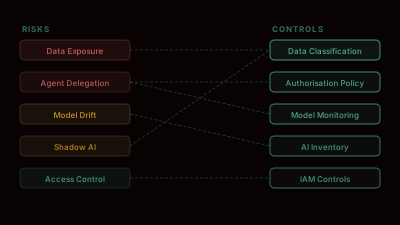
For the past decade, cybersecurity leaders focused on protecting systems, networks, and data. That remains essential. But AI is introducing a new category of risk that most organisations are not yet prepared to manage.
The integrity of the knowledge feeding our AI systems.
What the AI knowledge supply chain looks like
Most enterprise AI systems rely on complex information pipelines — not just the model itself, but everything that flows into it:
This creates something very similar to what we saw with the software ecosystem years ago: a knowledge supply chain. And just like software supply chains, these pipelines can be manipulated.
The emerging risks
The result is not always a traditional breach. The result can be something far more subtle: enterprise decisions based on corrupted knowledge.
The frameworks are starting to address this
Security leaders are already familiar with frameworks that begin to cover this challenge:
These frameworks increasingly emphasise data provenance, model governance, human oversight, and continuous monitoring of AI outputs. The direction is clear — even if most organisations have not yet operationalised it.
The role of the CISO is evolving
In practice, this means our responsibilities are expanding in a fundamental way.
We are no longer responsible only for protecting infrastructure.
We are becoming guardians of information integrity.
In an AI-driven enterprise, the most critical question may no longer be whether the system is secure. It is whether the knowledge the system uses can be trusted.
What this requires in practice
Securing the knowledge supply chain means extending security controls to cover:
Final thought
Organisations that begin securing their knowledge supply chains today will be far better prepared for the next phase of AI adoption.
Those that don't will be reacting under pressure — from regulators, customers, and attackers — to failures that were entirely predictable.
Secure your AI knowledge supply chain
Your AI is only as trustworthy as the knowledge feeding it. Assess your AI exposure across data provenance, RAG pipelines, and model governance — the controls most programmes are still missing.