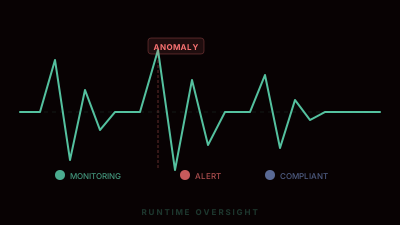
Most SOCs are built to detect malware, exploits, network anomalies, and known attack patterns. That is the right foundation. But AI introduces a fundamentally different class of threat — and your current detection stack was not designed for it.
What's changing
Attackers are no longer limited to code. They can now:
Manipulate AI systems using crafted inputs
Carefully constructed prompts that cause the system to behave in ways its designers never intended — without triggering any existing alert.
Influence outputs without breaching infrastructure
No lateral movement. No privilege escalation. No network traffic anomaly. The attack happens entirely within the application layer — in language.
Extract sensitive data through interaction patterns
Data exfiltration that looks like a normal query. The AI is the confused deputy — it has access, and it's been convinced to use it.
Degrade model reliability without triggering alerts
Gradual poisoning of memory, knowledge bases, or context that erodes the system's behaviour over time — invisibly.
This happens inside normal application flows. Your SOC tools are not looking there.
The detection gap
Your SOC is optimised for signals. AI attacks are semantic. The tools don't overlap.
✓ Your SOC detects
- Packets and network traffic
- Logs and system events
- Endpoint behaviour
- Identity anomalies
- Known attack signatures
✗ Your SOC cannot see
- Prompt content and intent
- Model output meaning
- Retrieval manipulation
- Semantic data leakage
- Context window poisoning
The critical point: these are not edge cases. They are the primary attack vectors against AI systems.
A prompt that causes data leakage looks like a normal request.
A poisoned context looks like valid input.
A manipulated output looks like a correct response.
Real-world exposure
If your environment includes any of the following, you already have an unmonitored attack surface:
AI-assisted customer support
Internal knowledge assistants
AI-driven analytics platforms
What CISOs must do now
This is not a tooling upgrade. It is a paradigm shift.
01
Extend detection from signals to semantics — your detection capability must reach inside the AI interaction layer, not just the network and endpoint layer.
02
Instrument AI interactions — prompt and response logging is not optional in a regulated environment. If you cannot see what your AI was asked and what it said, you cannot detect an attack.
03
Define unsafe outcomes, not just malicious inputs — the SOC needs to know what a bad AI response looks like, not just what a bad packet looks like.
04
Introduce AI-specific threat modelling — prompt injection, indirect injection, retrieval poisoning, output manipulation, and delegation abuse need to be in your threat register.
05
Align SOC with AI governance and data controls — detection without governance is incomplete. The SOC needs visibility into what AI systems are authorised to do — so it can detect when they deviate.
The board-level reality
You can have all of this in place:
Mature incident response capability
…and still be completely blind to AI-driven attacks.
Final thought
We built SOCs to detect malicious activity.
Now we must detect malicious meaning.
Most organisations aren't there yet. The ones that get there first will be the ones that treated AI security as an operational discipline — not an afterthought.
#CyberSecurity
#AI
#SOC
#AISecurity
#CISO
#PromptInjection
#SemanticSecurity
#AIGovernance
#OneCompliant™
Is your SOC instrumented for AI threats?
If your SOC cannot see semantic attacks, your AI estate is already exposed. Assess your AI exposure
to find the detection gaps before an adversary does — then see how enforcement closes them at runtime.