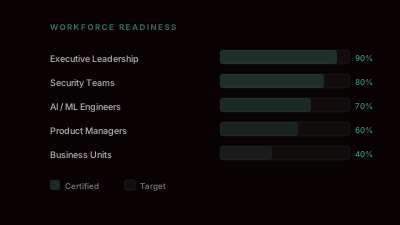
Every company runs security awareness training. Phishing simulations. Password hygiene. Basic data protection. It's necessary. But it's no longer sufficient.
The gap no one is addressing
Employees are already using AI — writing emails, summarising documents, uploading data for analysis, interacting with copilots and internal AI tools. Yet most awareness programmes don't train for this reality.
This creates a new kind of risk. Not malicious behaviour. Uninformed behaviour.
Sensitive data pasted into public AI toolsEmployees who do not understand the data processing implications of external AI services share internal information they would never email externally.
Internal documents uploaded "for convenience"Files containing PII, financial data, or internal procedures uploaded to AI tools for summarisation or translation — without understanding where that data goes.
AI-generated outputs trusted without validationEmployees acting on AI recommendations, summaries, or code without critical review — because the tool presents output with apparent confidence.
Employees granting tools access without understanding scopeOAuth permissions accepted without reading what access is being granted — giving AI tools access to email, calendar, files, or internal systems.
Prompts revealing more context than intendedThe detail people include in prompts to get better AI responses often contains sensitive business context, customer data, or internal procedures that should never leave the organisation.
This is not a policy problem
You can block tools. You can restrict access. But in reality: AI usage will happen — inside or outside your control. The answer is not restriction. It's better awareness.
In GenAI, the prompt is the new data exfiltration path.
What AI-aware security training must include
01
Tool Use — Judgement
When to use AI
When NOT to use AI
What tools are approved
Risks of external tools
02
Data Handling in AI Contexts
What data can enter AI systems
What must never be shared
How prompts expose context
How outputs can infer data
03
AI Security Awareness
Prompt injection awareness
Data leakage risks
Model hallucination and trust
Third-party AI tool risks
Identity and access implications
This is decision-making, not compliance. The goal is to give employees the judgement to navigate AI tools safely — not a checklist they forget by the next day.
Why this matters now
AI is accelerating faster than governance. Which means employees are becoming part of the attack surface in new ways. Not because they are careless — because they are untrained for this environment.
Employees are not the problem. Untrained employees in an AI-enabled environment are.
What CISOs should do
Integrate AI usage into security awareness programmes — not as an add-on module. As a core component.
Move from rules to judgement-based training — the AI landscape changes faster than rule sets. Employees need principles, not just policies.
Use real-world scenarios, not generic modules — training built around the actual AI tools your organisation uses, with realistic examples from your industry.
Align security, legal, and data governance messaging — employees receive conflicting guidance from different teams. One aligned programme is more effective than three competing ones.
Continuously update as AI capabilities evolve — a training programme built for 2023 AI tools is already outdated. Awareness must be a living programme, not an annual event.
Final thought
Traditional awareness taught
"Don't click the wrong link."
AI-era awareness must teach
"Don't expose the wrong information — even when the tool is helpful."
Security awareness didn't fail. It just hasn't evolved yet.
#CyberSecurity#AI#GenAI#SecurityAwareness#CISO#DataProtection#OASAP#OneCompliant™
Build AI security awareness that actually works
Technical controls fail when people are the weakest link. Assess your AI exposure to see where
workforce awareness — not just tooling — is the gap, and how the AI Awareness Programme (OASAP) closes it.