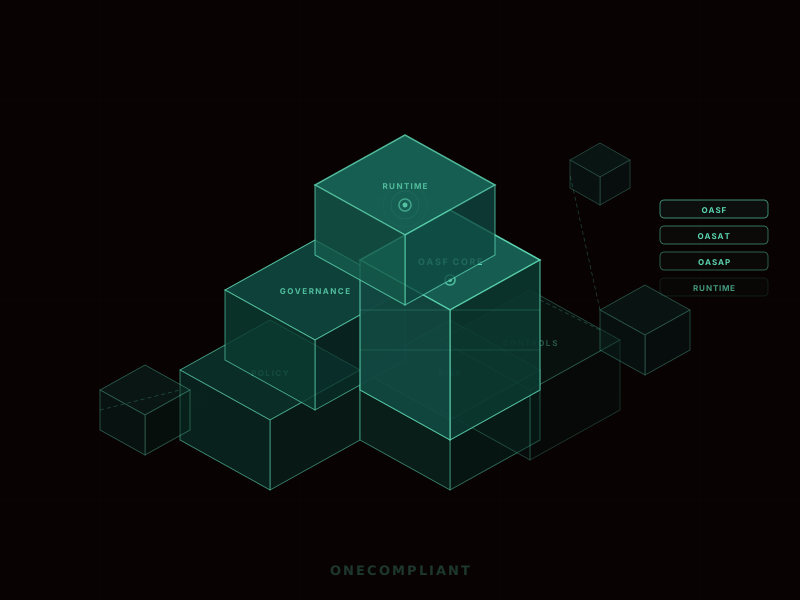
Much of the current discussion around AI security focuses on models, prompts, and guardrails. These matter. But the deeper issue is architectural — and most organisations have not yet confronted it.
As organisations deploy AI systems across operations, customer services, and internal automation, cybersecurity is facing a structural shift: the execution layer of the enterprise is becoming identity-driven and machine-operated.
The identity model has broken down
In traditional environments, identity management meant authentication and authorisation — confirming who a user is and whether they can access a system.
That traditional model is no longer sufficient. Today, a growing portion of enterprise activity is executed by non-human identities:
These entities authenticate correctly, possess valid permissions, and operate entirely within approved workflows. Yet they can still create significant risk.
Risk no longer begins at authentication. It emerges during execution.
An AI agent may be properly authenticated and authorised — but prompt injection, manipulated data, or compromised inputs can alter its behaviour. The system remains "authorised" while the actions become misaligned with business intent.
This is why cybersecurity programmes must evolve from static access control to continuous execution validation.
The structural adjustments CISOs must prepare for
Cybersecurity programmes designed for human-driven IT systems will not adequately secure autonomous and AI-driven enterprises.
Finish the foundation first
Everyone is talking about Agentic AI right now. Autonomous systems making decisions, executing actions, and influencing operational environments sounds powerful — and it is. But in critical or highly regulated industries, the instinct to jump straight to implementation is exactly the wrong one.
The response should always be the same: finish the foundation first.
Before deploying Agentic AI into sensitive environments, organisations must establish:
AI autonomy without governance is not innovation — it is unmanaged risk.
If speed is the priority, invest in experienced practitioners who can build the foundation correctly from the start. In environments where infrastructure, customer trust, or regulatory compliance are involved, getting it right the first time matters.
The sequence that works
The organisations that adapt first — by securing identity execution, AI data pipelines, and machine-driven workflows — will be the ones that can safely scale AI adoption.
The rest will struggle to control the very systems they deploy.
Assess your AI security architecture
A CISO-grade AI architecture is only as strong as the gaps you cannot see. Assess your AI exposure across identity, runtime monitoring, and pipeline controls — then see how enforcement holds the line.