We're entering a new phase of OT cyber risk — one where AI is no longer just helping defenders. It's empowering attackers. And the consequences for organisations that depend on industrial operations are severe.
Recent research from Shieldworkz and Nozomi Networks shows a dramatic shift in the threat landscape. What used to require advanced malware coding and deep ICS expertise can now be executed by low-skill actors using AI-enabled ransomware kits available for €200–€500. Tools like WormGPT, FraudGPT, and new open-source LLMs automate everything from reconnaissance to payload creation.
The numbers tell the story
Sources: Shieldworkz, Nozomi Networks, Honeywell OT/ICS research 2025. Figures represent industry estimates.
What it costs when OT goes down
These are not theoretical numbers. They reflect what manufacturers and industrial operators are actively experiencing:
OT downtime has become one of the most expensive categories of cyber impact — and adversaries know it.
AI is accelerating the entire kill chain
Botnets now mutate payloads in real time to avoid detection. Polymorphic code means yesterday's signature is useless today. Your traditional OT defences were not built for this.
The supply chain is the silent attack vector
While ransomware gains headlines, the real infiltration pathway is increasingly the supply chain. Adversaries are compromising third-party vendors — service providers, integrators, remote maintenance partners, and software suppliers — to gain privileged access into client OT networks.
These attacks are stealthy, persistent, and extremely difficult to detect until the final-stage payload detonates.
Your environment is only as strong as the security of every vendor connected to it.
What defenders must do now
The bottom line
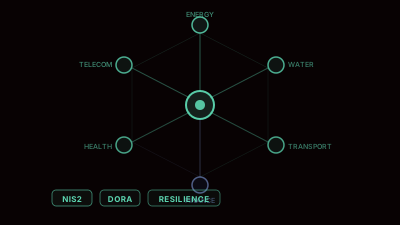
The threat landscape has changed. AI has turned ransomware into a scalable OT weapon. Any organisation that depends on industrial operations — manufacturing, energy, transportation, telecoms, utilities — is now a target.
Our defensive strategies must change with it.
If your organisation depends on uptime, safety, and industrial automation, it is time to rethink OT resilience in an AI-driven threat environment.
Is your OT environment ready for AI-driven threats?
AI is changing how OT environments are attacked and defended. Assess your AI exposure across OT posture, supply chain risk, and NIS2/CRA alignment before an AI-assisted adversary finds the gap first.